
TDEE Calculator
Accurately estimate your total daily calorie burn using the Mifflin-St Jeor formula to reach your weight, muscle, or performance goals.
Visit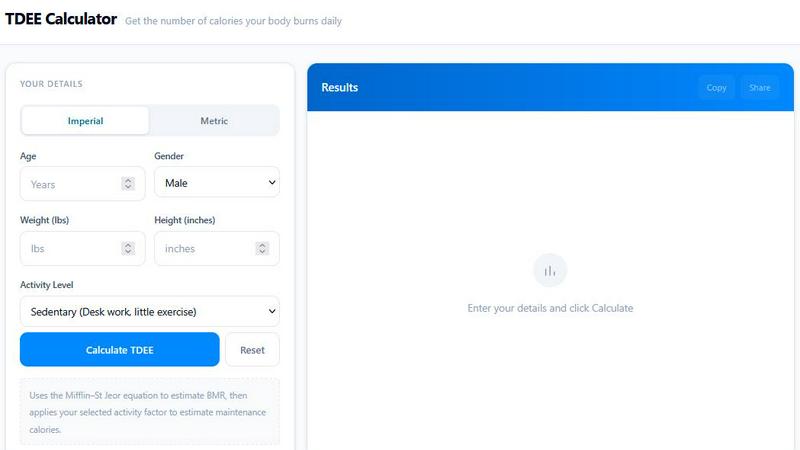
About TDEE Calculator
TDEE Calculator is a fast, accurate, and completely free online tool designed to help you estimate your Total Daily Energy Expenditure, or TDEE, which represents the total number of calories your body burns in a single day. By understanding this baseline, you can plan your daily calorie intake with confidence, whether your goal is fat loss, muscle gain, or weight maintenance. The tool is built for anyone looking to take control of their nutrition and body composition, from fitness beginners to experienced athletes. Its main value proposition lies in its simplicity and scientific foundation. Users simply enter their age, sex, height, weight, and activity level to instantly receive their maintenance calorie estimate. The calculator leverages the proven Mifflin-St Jeor equation, a method validated by research in the American Journal of Clinical Nutrition for accurately estimating resting metabolic rate in healthy adults. Beyond just a single number, TDEE Calculator provides practical, actionable insights including calorie deficit and surplus recommendations, macro guidance, and activity-based adjustments. This allows users to create a personalized nutrition plan that fits their specific lifestyle and goals. The tool is designed for speed, clarity, and practical use, serving as a reliable starting point that users can refine over time by tracking real-world results. It demystifies the science of energy balance, making it accessible and useful for everyday decision-making about diet and exercise.
Features of TDEE Calculator
Accurate Mifflin-St Jeor Calculation
The core of the tool is its use of the scientifically validated Mifflin-St Jeor equation to calculate your Basal Metabolic Rate, or BMR, which is the energy your body needs at rest. This formula is widely recognized for its accuracy in healthy adults, using your weight in kilograms, height in centimeters, and age to provide a reliable baseline. From this BMR, your TDEE is calculated by applying your selected activity factor, ensuring your estimate is grounded in proven physiology rather than guesswork.
Customizable Activity Level Selection
Understanding that no two lifestyles are the same, the calculator offers five distinct activity levels ranging from sedentary to athlete. Each level comes with a clear description, such as desk work with little exercise or hard training six to seven days per week. This feature allows you to fine-tune your calorie estimate to match your actual daily movement and exercise habits, providing a more personalized and realistic starting point for your nutrition planning.
Instant Calorie Deficit and Surplus Recommendations
Once your maintenance calories are calculated, the tool does not stop there. It provides immediate, practical recommendations for creating a calorie deficit for fat loss or a calorie surplus for muscle gain. For example, it suggests a daily deficit of roughly 250 to 500 calories for sustainable weight loss and a surplus of about 200 to 350 calories for building muscle without excessive fat gain. This feature transforms a simple number into a actionable plan.
Fast, Free, and User-Friendly Interface
The tool is designed for speed and clarity, allowing you to get your results in seconds. There is no need to create an account, sign up for a newsletter, or pay any fees. The interface is clean and intuitive, with clear input fields for imperial or metric units, a simple gender selection, and a prominent calculate button. Results are displayed instantly and can be easily copied or shared, making the entire process efficient and hassle-free for the user.
Use Cases of TDEE Calculator
Planning a Sustainable Fat Loss Journey
For individuals aiming to lose weight, the TDEE Calculator provides a crucial starting point by identifying their maintenance calories. Users can then create a moderate calorie deficit, typically 250 to 500 calories below their TDEE, to promote steady and sustainable fat loss. This approach avoids the pitfalls of overly restrictive diets, helping to preserve muscle mass and maintain energy levels, while providing a clear, data-driven target to work towards each day.
Structuring a Muscle Building Diet
Those focused on building muscle and increasing strength can use the calculator to determine their maintenance calories and then establish a controlled calorie surplus. By eating roughly 200 to 350 calories above their TDEE, users can provide their bodies with the extra energy needed for muscle protein synthesis and recovery from intense training. This strategic surplus helps maximize muscle gain while minimizing unwanted fat accumulation, supporting efficient and effective body recomposition.
Establishing a Baseline for Weight Maintenance
For individuals who have reached their goal weight or simply want to maintain their current physique, the TDEE Calculator offers a reliable maintenance calorie target. By consistently eating around this number and monitoring their weight over a few weeks, users can confirm the accuracy of their estimate. This use case is essential for long-term weight management, providing a stable nutritional foundation that prevents the gradual weight regain often seen after dieting.
Optimizing Performance for Active Lifestyles
Athletes and highly active individuals can use the tool to ensure they are fueling their bodies adequately for performance and recovery. By selecting the appropriate activity level, such as Heavy Exercise or Athlete, they can calculate the higher calorie needs required to support intense training sessions. This helps prevent the negative effects of undereating, such as fatigue, poor recovery, and hormonal imbalances, while also avoiding the lethargy that can come from overeating, ultimately optimizing their training output.
Frequently Asked Questions
What does TDEE mean?
TDEE stands for Total Daily Energy Expenditure. It is the total number of calories your body burns in a single day. This includes your Basal Metabolic Rate, which is the energy needed for basic life functions at rest, the energy required to digest and process food, and all the calories burned through physical movement and exercise. Knowing your TDEE is fundamental for managing your weight.
How is TDEE different from BMR?
BMR, or Basal Metabolic Rate, is the number of calories your body needs to perform basic life-sustaining functions like breathing, circulation, and cell production while at complete rest. TDEE is a broader number that includes your BMR plus all the additional calories burned through daily activities, exercise, and digesting food. Essentially, BMR is a component of your TDEE, which represents your total daily calorie burn.
How many calories should I eat to lose weight?
To lose weight, you should consume fewer calories than your Total Daily Energy Expenditure, creating a calorie deficit. A common and sustainable recommendation is to reduce your daily intake by 250 to 500 calories below your maintenance level. This deficit is typically enough to promote a steady loss of about 0.5 to 1 pound of body fat per week without causing excessive hunger or metabolic slowdown.
How accurate is this calculator?
This calculator provides a scientifically grounded estimate based on the Mifflin-St Jeor equation and your self-reported activity level. It is considered one of the most accurate methods for estimating resting metabolic rate. However, it is an estimate, not a perfect number. Individual variations in metabolism, body composition, and actual daily activity can affect accuracy. It is best used as a reliable starting point, which you can then refine by monitoring your weight and adjusting your intake by 100 to 200 calories as needed over 2 to 3 weeks.
Similar to TDEE Calculator


Caesura
Caesura is a macOS menu-bar app that reminds you to drink water, stretch, rest your eyes, and breathe on science-backed intervals.

Holly AI
Holly AI automates patient scheduling and front desk tasks to help clinics grow without burnout.

Droidal Insurance Verification AI Agent
Droidal Insurance Verification AI Agent ensures real-time eligibility checks and accurate coverage verification to eliminate surprises before care.