ProcessSpy
ProcessSpy is an advanced Mac process monitor with a native interface, real-time filtering, and detailed system insights.
Visit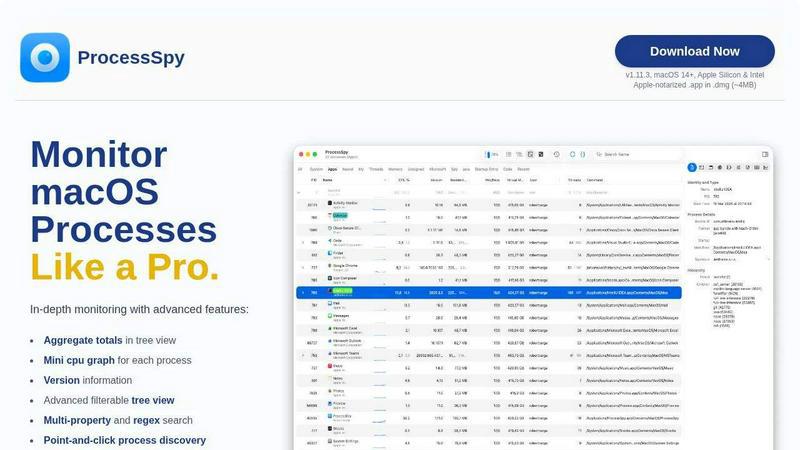
About ProcessSpy
ProcessSpy is a professional-grade process exploration and monitoring utility designed exclusively for macOS. It serves as a powerful, native alternative to tools like Sysinternals Process Explorer for Windows, providing macOS users and developers with deep, actionable insights into system and application activity that are not available in the default Activity Monitor. The tool is engineered for clarity and control, allowing users to visualize the hierarchical relationships between processes, inspect open files and network connections, view environment variables, and terminate unresponsive applications with precision. Its core value proposition lies in exposing the hidden details of macOS processes, such as full command-line arguments, version information, and bundle identifiers, which are essential for debugging, system administration, and performance analysis. Built with a focus on the macOS ecosystem, ProcessSpy utilizes native APIs and UI frameworks to ensure a fast, responsive, and integrated experience without the bloat of cross-platform toolkits. It is an indispensable tool for software developers, IT professionals, security researchers, and power users who need to understand exactly what is running on their Mac, diagnose resource issues, and manage processes effectively.
Features of ProcessSpy
Advanced Hierarchical Process Tree
ProcessSpy presents all running processes in a detailed, collapsible tree view that clearly shows parent-child relationships. This visualization is crucial for understanding which applications launched which services or sub-processes. Beyond simple hierarchy, this view includes aggregate totals for CPU usage, memory consumption, and thread counts for any parent process, providing an immediate overview of an entire application's resource footprint. The tree view is fully integrated with the tool's powerful real-time filtering and search capabilities.
Multi-Property and Regex Search
The quick-search functionality in ProcessSpy is exceptionally powerful, supporting regular expressions and simultaneous searches across multiple process properties. For instance, you can search for processes with "java" in the name and "-Xmx1024m" in the command-line arguments. This granular searchability allows users to quickly pinpoint specific processes among hundreds, making it far superior to the basic search found in Activity Monitor and essential for troubleshooting complex software environments.
JavaScript-Based Filtering
For advanced users, ProcessSpy offers the ability to define custom filters using JavaScript. This feature enables the creation of complex, multi-condition filters that can evaluate any property of a process. You can write scripts to show only processes consuming memory above a certain threshold, those started after a specific time, or processes with specific entitlements, offering unparalleled flexibility for monitoring and analysis tailored to exact needs.
Comprehensive Process Context & History
ProcessSpy provides deep contextual information for each process. The free version includes version details and point-and-click discovery. A paid license unlocks advanced data like environment variables, code signatures, entitlements, Info.plist contents, and bundle IDs. Furthermore, the paid version can record historical metrics (CPU, memory, threads) for export to CSV and remembers finished processes with their full details for later forensic review, a feature absent from most system monitors.
Use Cases of ProcessSpy
Software Development and Debugging
Developers can use ProcessSpy to debug applications by inspecting the exact command-line arguments, environment variables, and linked libraries (dylibs) of their running processes. It helps distinguish between multiple instances of the same runtime (e.g., different Java versions) by displaying version and path information, which is critical for resolving dependency conflicts and understanding runtime behavior during development and testing phases.
System Performance Analysis and Troubleshooting
IT professionals and power users can diagnose system slowdowns or high resource usage effectively. The aggregate totals in the tree view quickly identify which application family is consuming excessive CPU or memory. The ability to view open files and network connections per process helps pinpoint applications causing disk I/O issues or suspicious network activity, leading to faster resolution of performance bottlenecks.
Security Auditing and Malware Detection
Security researchers can utilize ProcessSpy to audit system activity for anomalies. Features like viewing entitlements, signature information, and startup agents/daemons help identify suspicious or unauthorized processes. The tool's capability to flag newly discovered processes and remember terminated ones aids in forensic analysis, allowing an investigator to see what was running on a system and what it was doing.
Managing and Terminating Stubborn Processes
When an application becomes unresponsive or fails to close completely, Activity Monitor may not provide enough detail to safely force-quit the correct process, especially with complex applications that spawn multiple sub-processes. ProcessSpy's detailed tree view shows the exact hierarchy, allowing users to confidently terminate the root process or specific child processes without guessing, ensuring a clean shutdown.
Frequently Asked Questions
Is ProcessSpy safe to install on my Mac?
Yes, ProcessSpy is completely safe. It is an Apple-notarized application, meaning it has been scanned and approved by Apple for malicious content. It is distributed as a signed .app file inside a .dmg disk image, ensuring its integrity. It runs natively on both Intel-based Macs and Apple Silicon (M-series) Macs without requiring any kernel extensions or lower-level system modifications.
What versions of macOS does ProcessSpy support?
ProcessSpy is designed for modern versions of macOS. It officially supports macOS 14 (Sonoma) and newer, including the latest releases. The developer also notes support for the future macOS 26 (Tahoe), indicating a commitment to compatibility with upcoming OS versions. It is not intended for older, legacy versions of macOS.
What is the difference between the free and paid versions?
The free version of ProcessSpy offers robust core functionality, including the advanced process tree, multi-property search, JavaScript filters, version info, and basic process termination. A one-time paid license unlocks advanced features such as viewing environment variables, process entitlements, Info.plist data, recording and exporting process history, and the ability to review details of finished processes.
What is the license model for the paid version?
The license for ProcessSpy's premium features is a one-time purchase of $24.99. This is a lifetime license that includes all future updates and new features at no additional cost. The license is per user and can be used on an unlimited number of personal devices, making it a cost-effective solution for professionals who use multiple Macs.
Similar to ProcessSpy

stackledge
The human-curated directory of active SaaS, practical AI tools, and custom n8n workflows. Discover software that works, backed by real upvotes.

WidgIq
Provide an AI-powered customer support widget for your website

Product Launch Checklist
A free launch checklist for SaaS, apps, AI tools and more. Every step says why it matters and when you can skip it.

Forms Plugin
The #1 Native Form Builder Plugin for Framer - No Code, No Embeds, No External Platforms.

Chatit Me - Free Random Chat Alternative
Chat with random strangers online for free on ChatIt.me. Enjoy safe, anonymous, and instant 1-on-1 conversations with people worldwide

VidhyaGen
Fast, free, and privacy-first browser tool to convert, crop, resize, and compress images locally without server uploads.