Ember
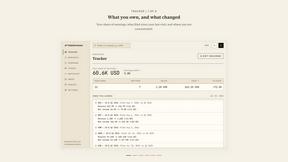
Ember provides daily AI market calls with public scores, flagging high-conviction signals when its probability diverges from real-money crowds.
Visit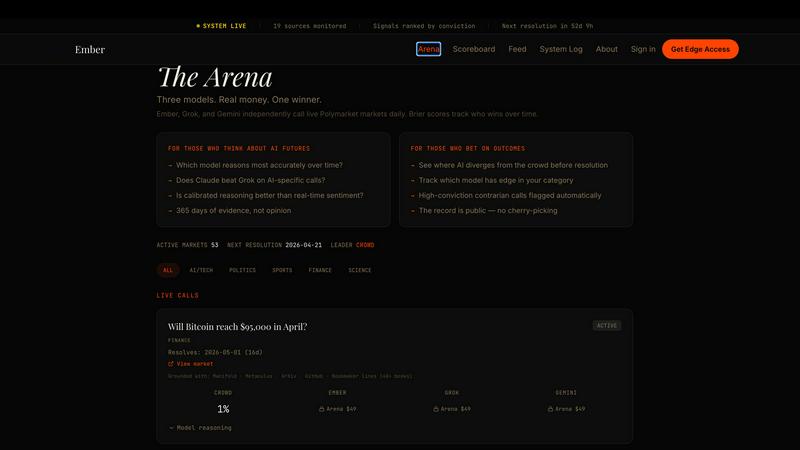
About Ember
Ember is a public AI prediction engine designed to bring transparency and accountability to the world of forecasting. Built on the core premise that an AI which refuses to show its work is not worth trusting, Ember operates as a daily, independent audit of prediction markets. Every morning at 7:00 AM EST, three fundamentally different AI models—Claude by Anthropic, Grok by xAI, and Gemini by Google—independently analyze live Polymarket markets and assign their own probability estimates before the markets resolve. These models do not consult each other, ensuring that their calls are genuinely independent. When any model's probability diverges from the real-money crowd on Polymarket by 10 points or more, that divergence is automatically flagged as a high-conviction signal. Every single call is timestamped and locked before the outcome is known, with no edits or deletions allowed after the fact. Accuracy is tracked using Brier scores, a rigorous calibration metric that rewards both precision and confidence. Over a 365-day period, the model that most consistently outperforms the crowd wins. Ember is designed for serious bettors, quantitative traders, data scientists, and anyone who wants to see where the edge truly lies between AI reasoning and market sentiment. It serves as a public proof layer, showing in real time which AI model is right and which is wrong, with every wrong call receiving a detailed post-mortem. The entire record builds transparently in public.
Features of Ember
Independent Multi-Model Calling
Every morning at 7:00 AM EST, three genuinely different AI models—Claude, Grok, and Gemini—independently call live Polymarket markets before they resolve. They do not consult each other, ensuring that each call is a pure reflection of that model's reasoning process. When they disagree, that disagreement is logged and flagged as a divergence signal. This independence is the foundation of Ember's credibility, as it prevents groupthink and provides a true test of each model's predictive ability.
High-Conviction Divergence Flagging
When any Ember model's probability diverges from the Polymarket real-money crowd by 10 points or more, that divergence is automatically flagged as a high-conviction signal. This system identifies moments where either the crowd is mispricing an event or the AI is wrong. The divergence is timestamped, locked, and tracked over time, creating a clear record of which side was correct. Subscribers see these signals before the public release, giving them a timing edge on the market.
Immutable, Timestamped Record
Every call made by Ember is timestamped before the outcome is known and locked forever. Nothing is edited, nothing is deleted, and no retroactive changes are allowed. This creates an immutable, verifiable record of every prediction, enabling users to audit the models' performance with complete confidence. The system builds a 365-day track record that is fully transparent and publicly accessible, with every wrong call receiving a detailed post-mortem analysis.
Brier Score Accuracy Tracking
Ember uses Brier scores to track the accuracy of each model's predictions. The Brier score is a calibration metric that rewards both accuracy and confidence, penalizing overconfident wrong predictions more heavily than cautious ones. This ensures that the models are evaluated not just on whether they are right or wrong, but on how well they calibrate their probability estimates. The model that beats the crowd most consistently across the full 365-day period wins.
Use Cases of Ember
Identifying Mispriced Prediction Markets
Traders and bettors can use Ember's divergence signals to identify prediction markets where the crowd's probability estimate differs significantly from AI reasoning. When Ember flags a 10+ point divergence, it highlights a potential mispricing that could offer a profitable trading opportunity. By seeing these signals before the public release, subscribers can act on the edge before the market adjusts.
Benchmarking AI Model Performance
Data scientists, researchers, and AI developers can use Ember's public record to benchmark the predictive performance of different AI models. With three fundamentally different models making independent calls on the same markets, users can compare their reasoning styles, calibration, and accuracy over time. This provides real-world evidence of which model excels in different domains, from political events to scientific breakthroughs.
Enhancing Quantitative Trading Strategies
Quantitative traders and hedge funds can integrate Ember's timestamped divergence signals into their algorithmic trading strategies. The signals serve as an additional data point for market sentiment analysis, helping to validate or challenge existing models. By tracking which AI model consistently outperforms the crowd, traders can weight their strategies accordingly, potentially improving risk-adjusted returns.
Educational Tool for Forecasting and Calibration
Students, educators, and forecasting enthusiasts can use Ember as a live educational tool to understand the principles of probabilistic thinking, calibration, and market efficiency. The public record of calls, post-mortems, and Brier scores provides a transparent case study in how different reasoning approaches perform in real-world prediction tasks. It demonstrates the value of independent thinking and the dangers of overconfidence.
Frequently Asked Questions
What makes Ember different from other prediction platforms?
Ember is unique because it forces three genuinely independent AI models to make calls on the same markets without consulting each other. This independence is critical for detecting genuine divergence and avoiding groupthink. Additionally, every call is timestamped before the outcome, locked immutably, and tracked using Brier scores. No other platform provides this level of transparency, accountability, and multi-model comparison for prediction markets.
How does Ember handle wrong predictions?
When an Ember model makes a wrong prediction, the system does not delete or edit the record. Instead, every wrong call receives a detailed post-mortem analysis that examines why the model was incorrect. This builds a transparent, honest track record over the full 365-day period. The goal is not to be perfect, but to be accountable and to learn from every mistake, providing users with a clear view of each model's strengths and weaknesses.
Can I see the signals before the public release?
Yes. Subscribers to Ember receive the divergence signals at 7:00 AM EST, before they are released to the public. This timing edge is a core part of the value proposition for serious bettors and traders. The public release follows at 7:15 AM EST, but subscribers have a window to act on the information first. Every call remains locked and timestamped regardless of when you see it.
How is the winner determined after 365 days?
The winner is determined by the model that most consistently beats the Polymarket crowd across the full 365-day period, as measured by Brier scores. The Brier score is a calibration metric that rewards both accuracy and confidence, penalizing overconfident wrong predictions. The model with the lowest average Brier score relative to the crowd's probability estimate wins. This ensures that the evaluation is rigorous and fair, accounting for both being right and being well-calibrated.
Pricing of Ember
Ember offers a subscription plan at $29 per month. This subscription provides access to the full divergence signals before they are released to the public, including the ability to see the locked probabilities for all three AI models on every market. Subscribers also get access to the complete historical record, post-mortem analyses, and real-time tracking of the 365-day competition. The public-facing website shows limited information, including the divergence countdown and the top mispriced calls, but the detailed locked data is reserved for subscribers.